- Call: +91-8904100674
- Email: support@quickcurd.com

Instructor: Vinay Kumar
What you'll achieve
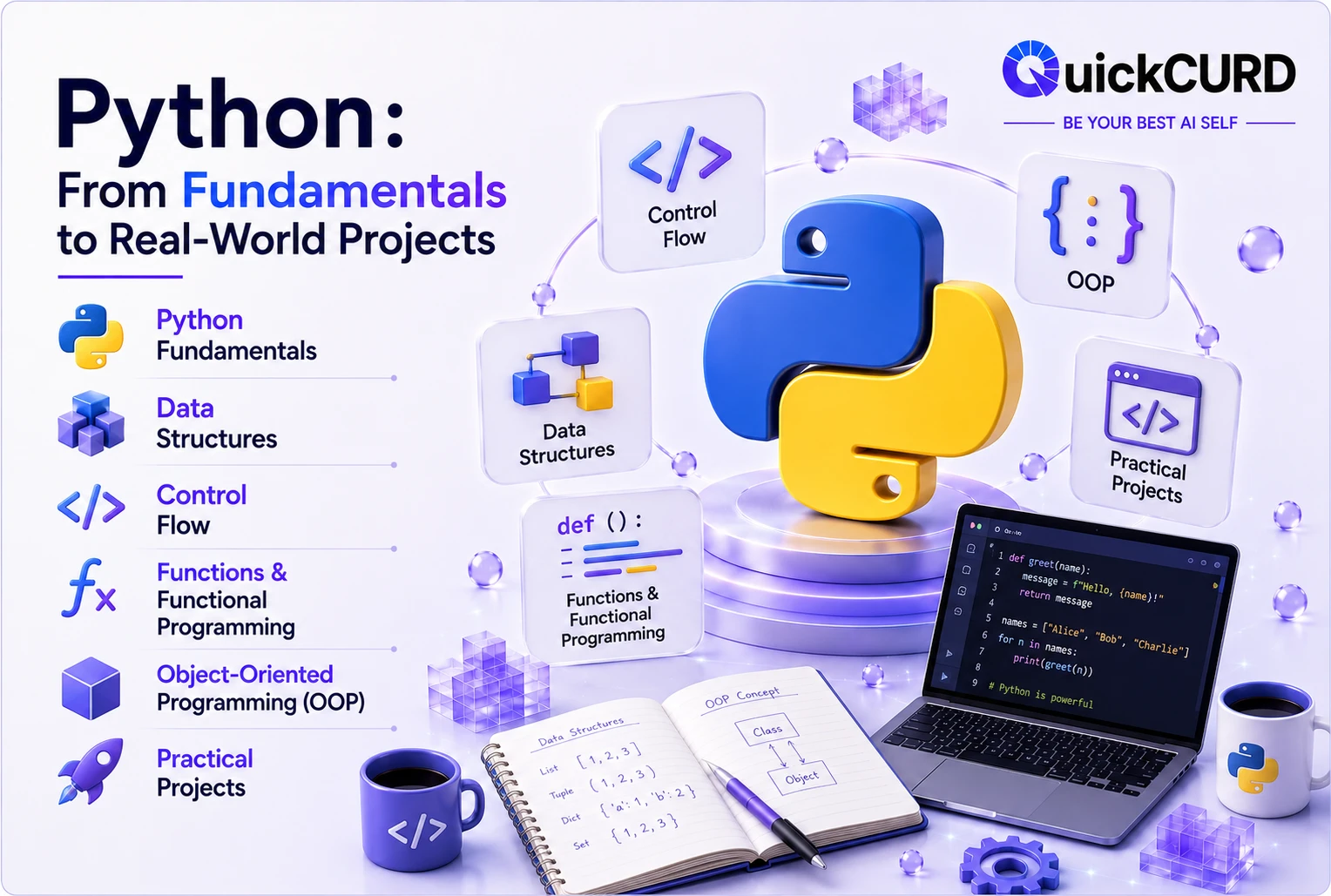
Gain fluency in Python syntax, all major data structures, control flow, and functional programming patterns — the essential toolkit for every data science and AI workflow.
Language basics, operators, and I/O
• What is a programming language? Why Python for AI?
• Variables, types: int, float, str, bool, complex
• Operators: arithmetic, comparison, logical, bitwise, assignment
• Input/output, type conversion, f-strings
Lists, tuples, sets, dicts, strings
• Lists: indexing, slicing, mutability, methods
• Tuples: immutability and packing/unpacking
• Sets: uniqueness, union, intersection, difference
• Dictionaries: key-value pairs, nesting, iteration
• String methods: split, join, format, f-strings
Decision-making and iteration
• if / elif / else conditional statements
• for loops: range
• while loops: condition-based repetition
• break, continue, pass, nested loops
Reusable, expressive Python code
• def, parameters, return, default args
• Lambda: anonymous one-liners
• enumerate() and zip()
• List comprehensions
• map(), filter(), reduce()
Object-oriented programming in Python
• Defining classes: init, self, instance variables
• Methods, properties, dunder methods
• Inheritance and method overriding
• OOP patterns in ML frameworks (sklearn, PyTorch)
Build Small Library, Web Scraper, Calculators, Password generator, Todo List App, Number Guesser
1. Master lists, dicts, sets — 80% of data wrangling uses them
2. List comprehensions and lambdas make code Pythonic
3. Functions are first-class objects — pass, return, store them
4. OOP underpins every major ML/DL framework
0 Reviews

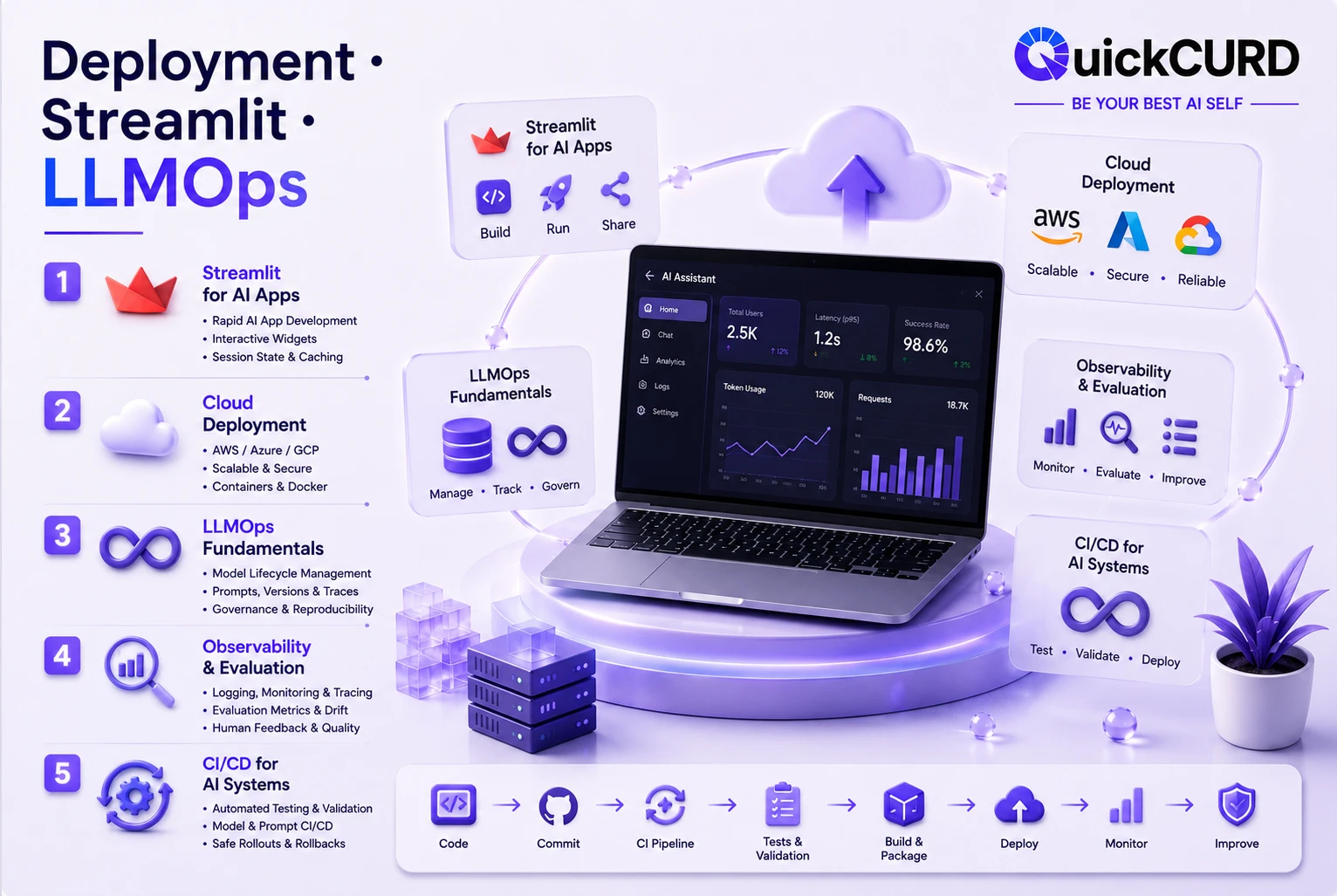
Package AI apps into Streamlit UIs, deploy on public cloud (AWS/GCP), implement LLMOps monitoring with LangSmith, establish CI/CD for AI, and understand LLMOps as a discipline.
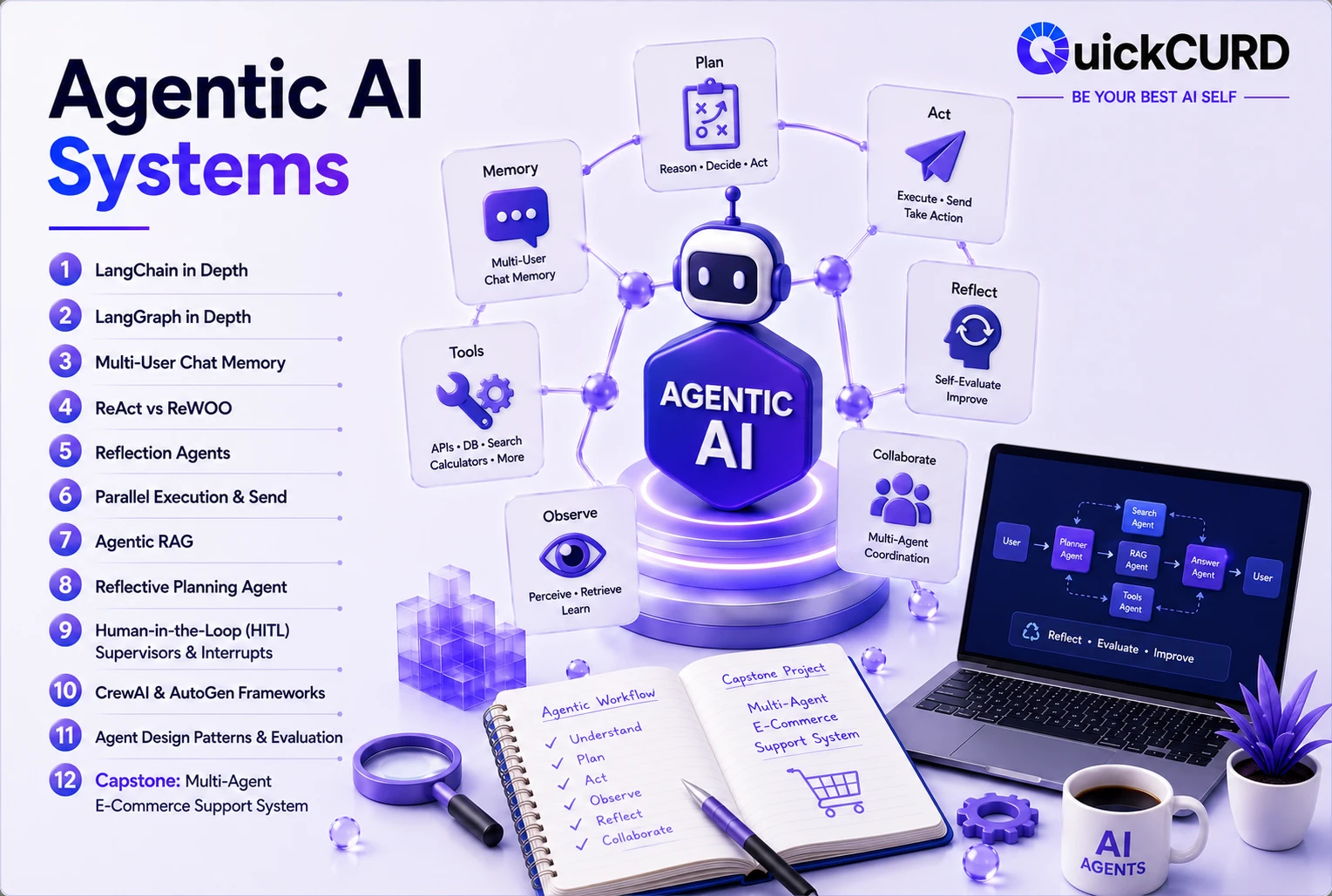
Build AI agents from first principles, design stateful LangGraph workflows, implement all major agent patterns compare CrewAI vs AutoGen, and ship a production multi-agent e-commerce support system.
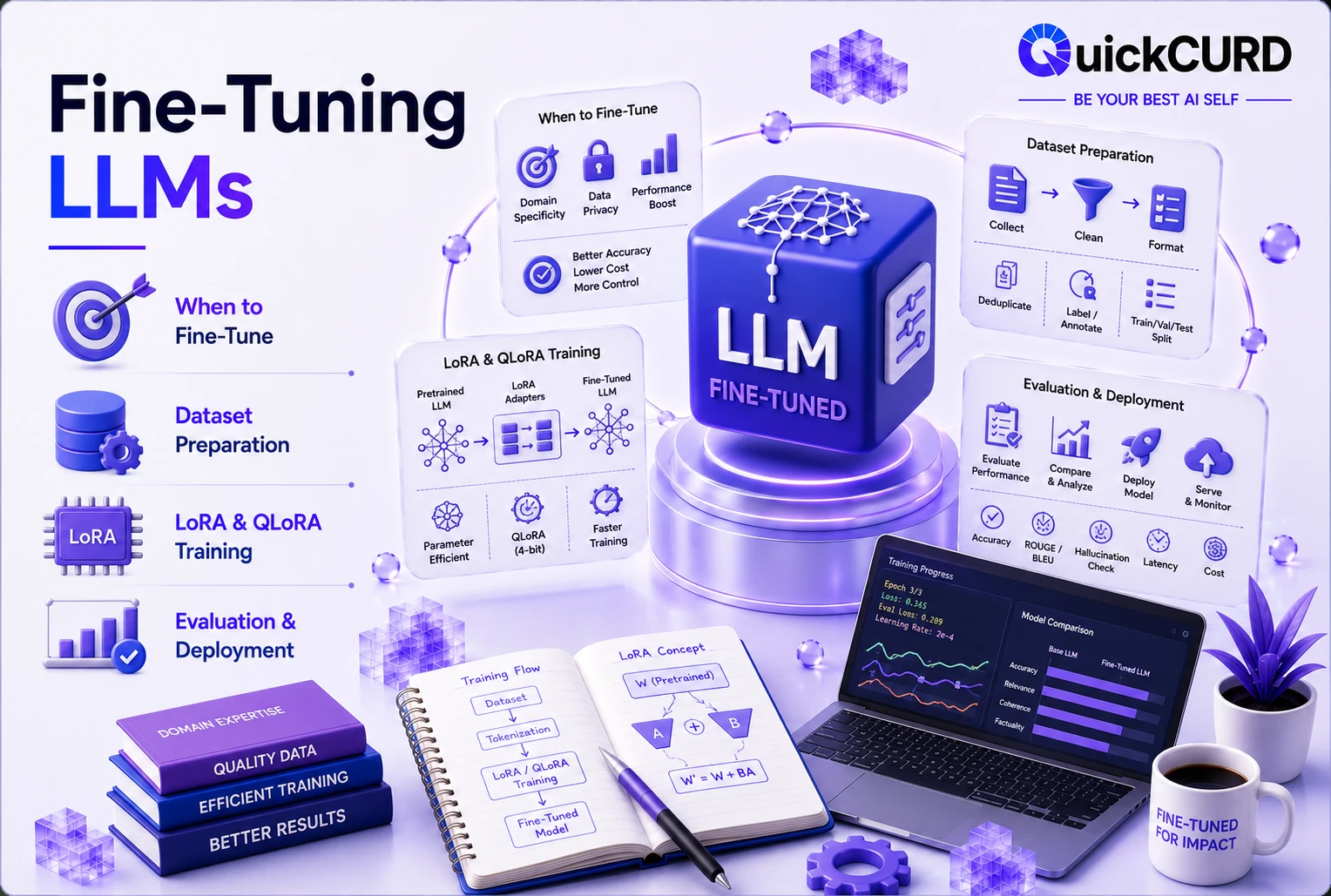
Decide when fine-tuning beats prompting and RAG, implement LoRA/QLoRA, prepare high-quality datasets, evaluate models, and deploy fine-tuned adapters to production.