- Call: +91-8904100674
- Email: support@quickcurd.com

Instructor: Vinay Kumar
What you'll achieve
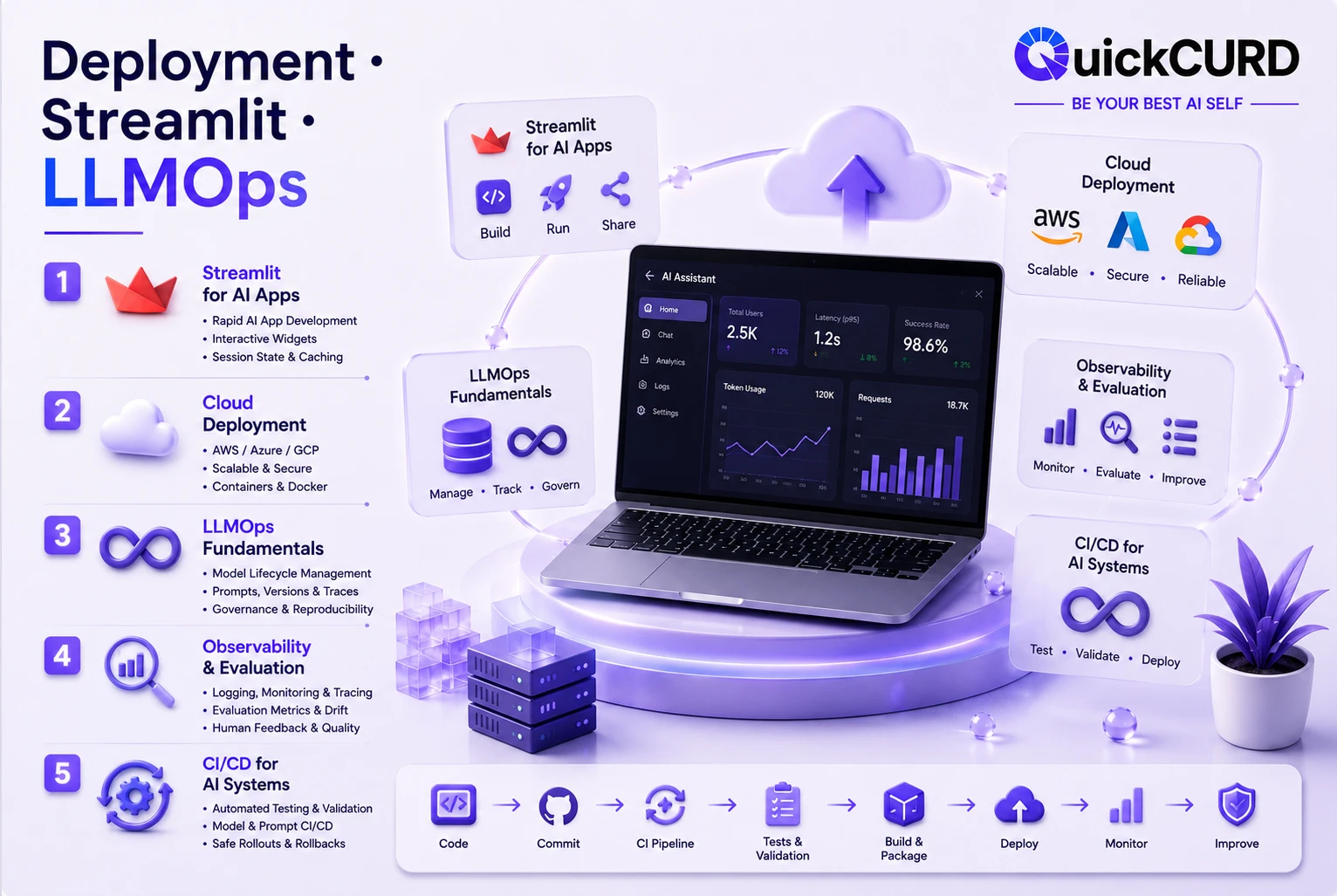
Package AI apps into Streamlit UIs, deploy on public cloud (AWS/GCP), implement LLMOps monitoring with LangSmith, establish CI/CD for AI, and understand LLMOps as a discipline.
Rapid UI for LLM and ML applications
• Streamlit fundamentals: layout, widgets, session state
• Building chat interfaces for LLM agents
• File upload, rich output, multi-turn state
• Connecting Streamlit to LangChain/LangGraph
Taking apps live on public cloud
• Docker containerisation for AI apps
• Streamlit Community Cloud: free public hosting
• AWS: EC2, ECS, Lambda + API Gateway
• GCP: Cloud Run, Vertex AI deployment
Operating LLMs in production
• What is LLMOps? Comparison with MLOps
• Prompt versioning and experiment tracking
• LangSmith: tracing, evaluation, datasets
• Cost monitoring: token usage and API budgets
Measuring quality over time
• Logging agent traces and intermediate steps
• LangSmith evaluation runs and quality scoring
• Regression testing for quality drift detection
• User feedback loops and RLHF signal collection
Shipping AI safely and continuously
• Git-based workflow for prompt and code changes
• Automated test suites for LLM outputs
• Blue/green deployment for zero-downtime updates
• Program summary: the complete AI mastery stack
1. Streamlit turns a notebook into a web app in minutes
2. Docker + Cloud Run is the fastest path to a production URL
3. LLMOps = MLOps + prompt versioning + trace observability
4. LangSmith tracing is non-negotiable for debugging agents
5. CI/CD for AI means testing prompts, not just code
6. Full stack complete: concept → code → deploy → monitor
0 Reviews

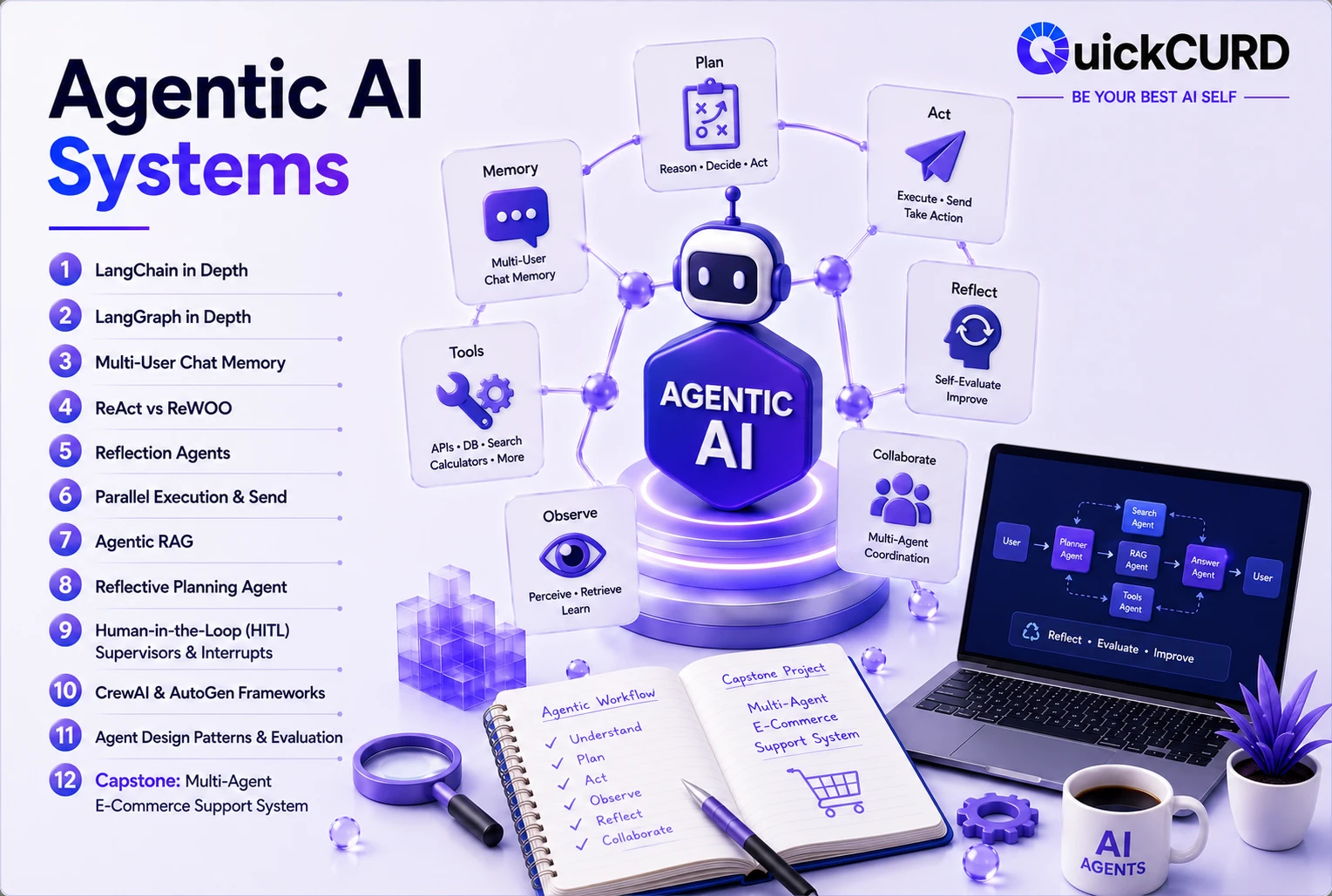
Build AI agents from first principles, design stateful LangGraph workflows, implement all major agent patterns compare CrewAI vs AutoGen, and ship a production multi-agent e-commerce support system.
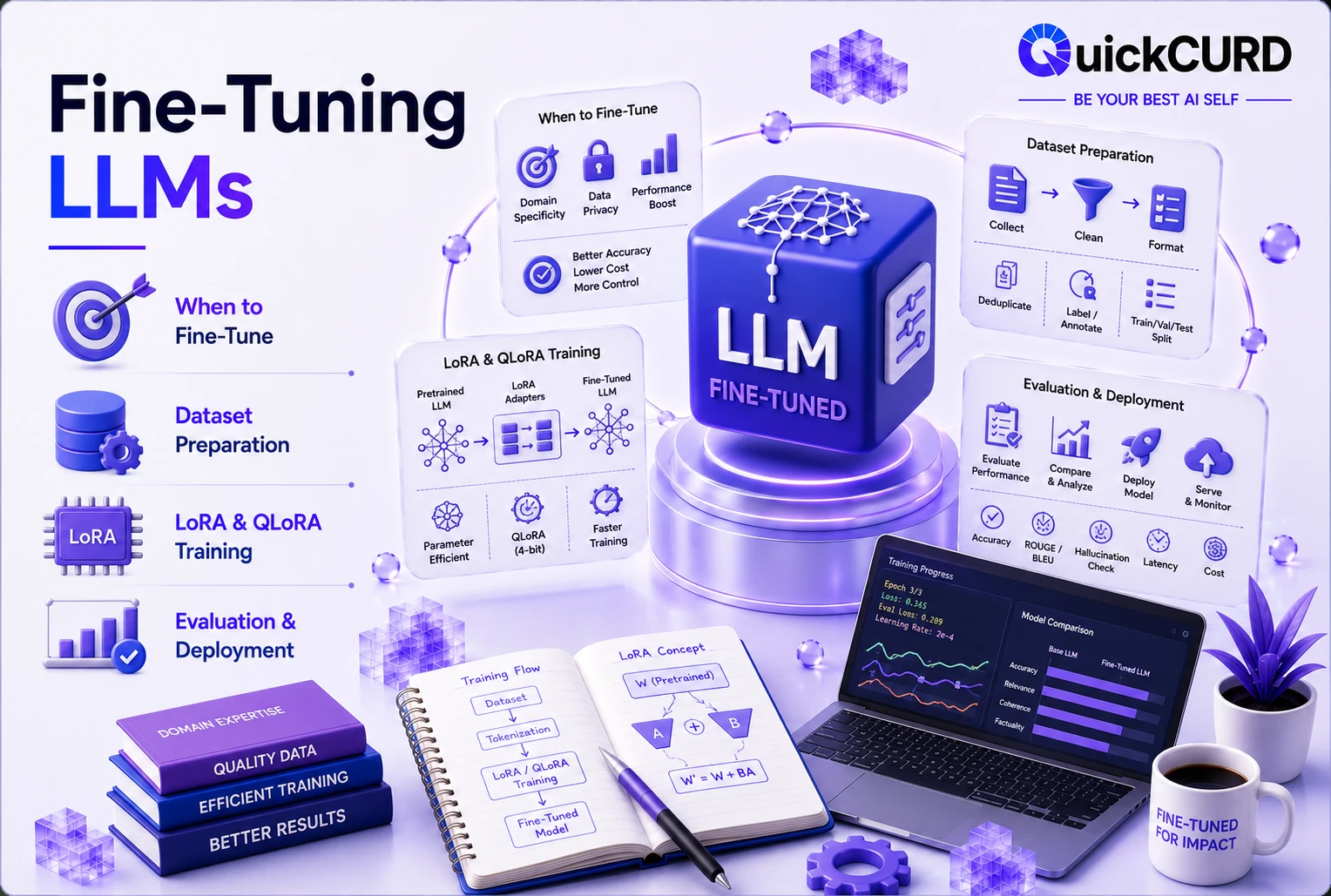
Decide when fine-tuning beats prompting and RAG, implement LoRA/QLoRA, prepare high-quality datasets, evaluate models, and deploy fine-tuned adapters to production.
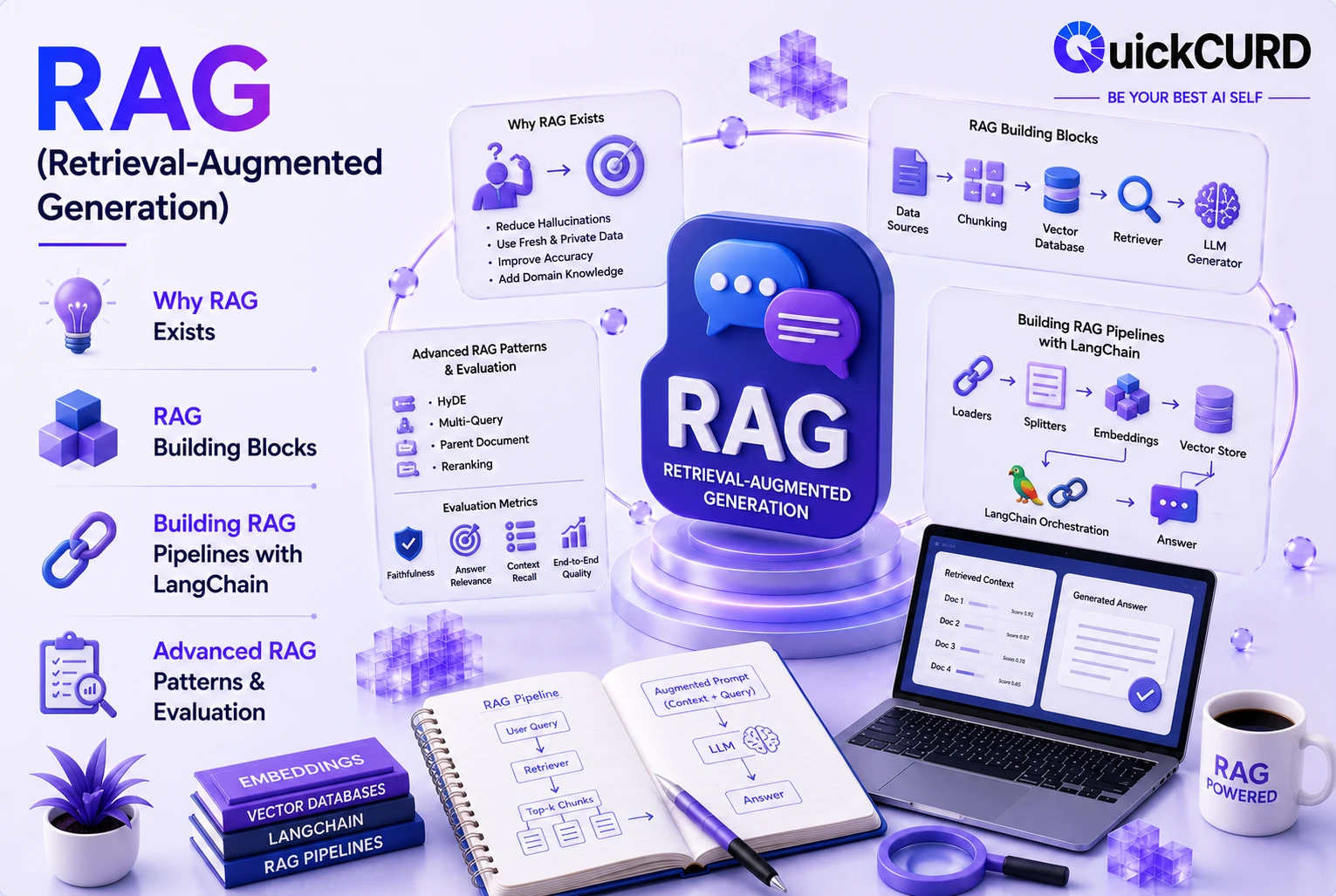
Understand why RAG solves hallucination and knowledge-cutoff problems, build complete RAG pipelines with embeddings and vector stores, and implement advanced retrieval patterns.