- Call: +91-8904100674
- Email: support@quickcurd.com

Instructor: Vinay Kumar
What you'll achieve
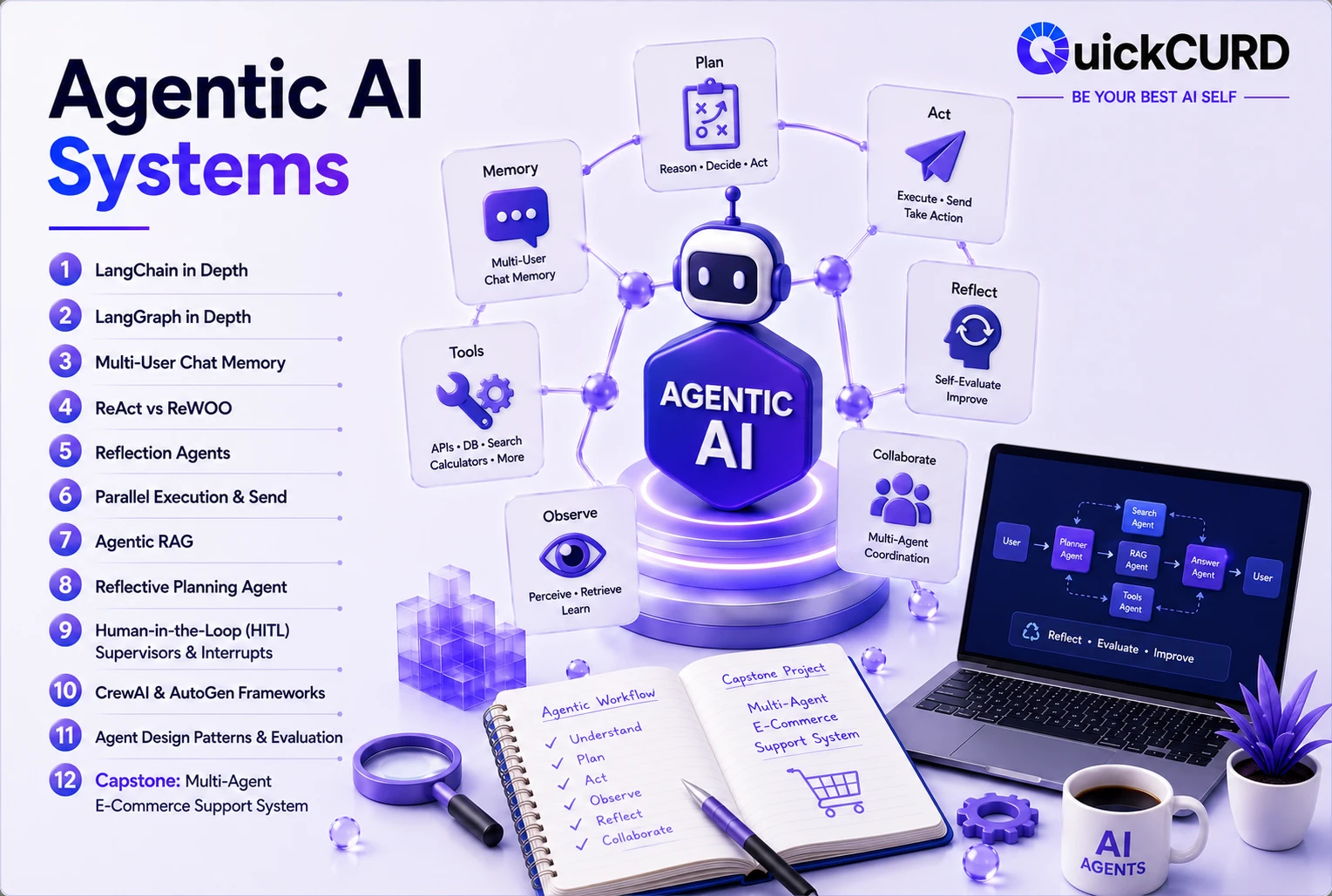
Build AI agents from first principles, design stateful LangGraph workflows, implement all major agent patterns, compare CrewAI vs AutoGen, and ship a production multi-agent e-commerce support system.
Foundation models, tools, memory, MCP
• Prompt vs Fine-Tuning vs RAG vs Agentic decision map
• Get Ready: API, Structured Output (using Schema), Custom Tool: Search Tools (Agent), Memory, State, Multimodal, Project: (Personal Chef)
• Get Application Ready: Runtime, MCP (intro), Sub Agent, Multi Agent, RAG-SQL Agent, Project: (Wedding Planner)
• Get Production Ready: Message, Memory, Dynamic: Models, Prompts, Tools, Human in the loop, Project: (Email Agent)
• Utilizing MCP Servers
Stateful graph-based agent workflows
• Python: State Variable, Node definitions, Pydantic
• LangGraph: StateGraph, Nodes, Edges, Shared State, Graph Builder and Graph Visualizing
• Sequential Workflow, Multiple Inputs, Conditional Routing, Looping, React
• LKTM Framework: L: LLM, M: Memory, Short Term, Long term, Working memory, K: Knowledge Base, T: Local, API, MCP, Pydantic, Reducer Logic, Schema Modification
Isolated per-user conversational state
• Thread-based conversation isolation
• Token-controlled memory with context trimming
• Persistent InMemorySaver checkpointer
• Switching between users and memory view
Reasoning architecture deep dive
• ReAct: Reason + Act interleaved loop
• ReWOO: Reasoning Without Observation (plan-first)
• Head-to-head: research assistant task
• Decision framework + hybrid approaches
Self-correcting code generation
• Generator → Evaluator → Reflector loop
• Code Writer + Code Reviewer agent pair
• Iterative self-correction until tests pass
Fan-out, map-reduce, dynamic parallelism
• Linear vs parallel workflow comparison
• Annotated state with operator.add for fan-out
• Send construct: dynamic parallel execution
• Map-Reduce for scalable batch processing
RAG design patterns in LangGraph
• Router RAG, Corrective RAG (CRAG)
• Self-Reflective RAG, Adaptive RAG
• Speculative RAG, Self-Routing RAG
• Complexity vs flexibility comparison guide
Multi-step complex query project
• Reflective Dynamic Planning Agent architecture
• Web research sub-agent with tool-use graph
• Plan → Execute → Replanner → reflection loop
• End-to-end: multi-step complex query analysis
Safety and human oversight
• HITL: reviewing tool calls, validating outputs, Interrupt
• construct, Command class: approve/reject Subgraphs and supervisor architecture, Multiturn Conversion
• FailSafe patterns for production systems
Multi-framework comparison
• CrewAI: role-based agents, hierarchical mode
• AutoGen: GroupChat, nested chat, sequence agents
• LangGraph Supervisor vs CrewAI vs AutoGen
• Framework selection decision guide
Coordination pattern mastery
• Design Patterns using Langgraph: Single Agent Pattern, ReAct Pattern, Custom Logic Pattern, Sequential Pattern, Parallel Pattern, Loop Pattern
• Quality and Refinement Pattern, Iterative Refinement Pattern, Review & Critique Pattern, Orchestration & Emergent Pattern
• HITL, Trust & Reputation, Governance
• Evaluating Agents using Langsmith, DeepEval, Arize
• Deployment, Monitoring and QC of Agents using Langsmith
Production multi-agent build
• ShopSmart multi-agent customer support architecture
• PII redaction, RAG knowledge base, Supervisor router
• Specialist agents: Orders, Returns, Billing, Product
• HITL escalation for Platinum customers
• Login-based e-commerce deployment + system metrics
1. Agent = LLM + tools + memory + goal
2. ReAct is foundational — master it before multi-agent systems
3. Agentic RAG combines retrieval intelligence with agent reasoning
4. Understanding why 40–80% of naive MAS implementations fail
5. CrewAI = role-based; AutoGen = conversation-based flexibility
6. LangSmith tracing separates a demo from a production system
0 Reviews

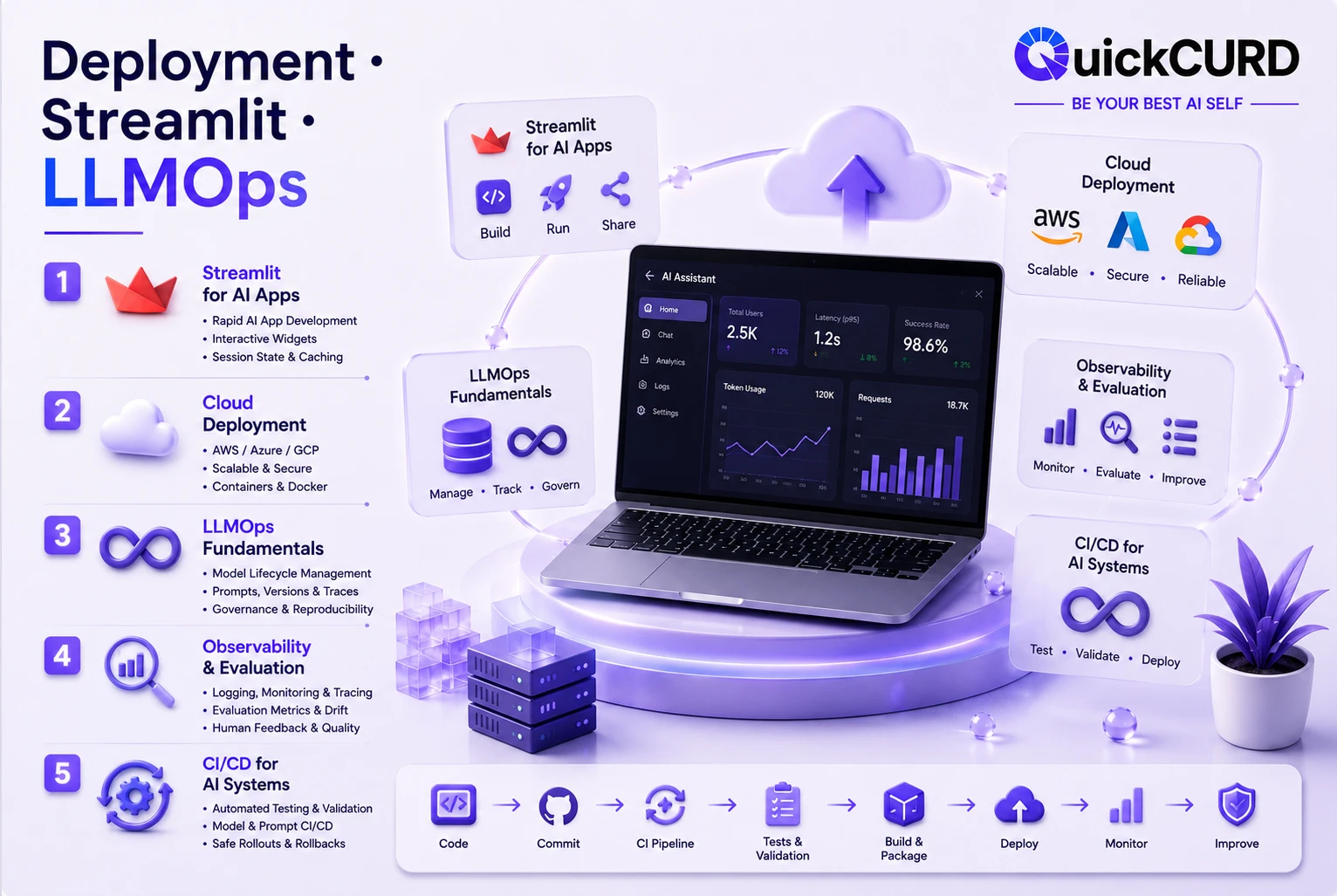
Package AI apps into Streamlit UIs, deploy on public cloud (AWS/GCP), implement LLMOps monitoring with LangSmith, establish CI/CD for AI, and understand LLMOps as a discipline.
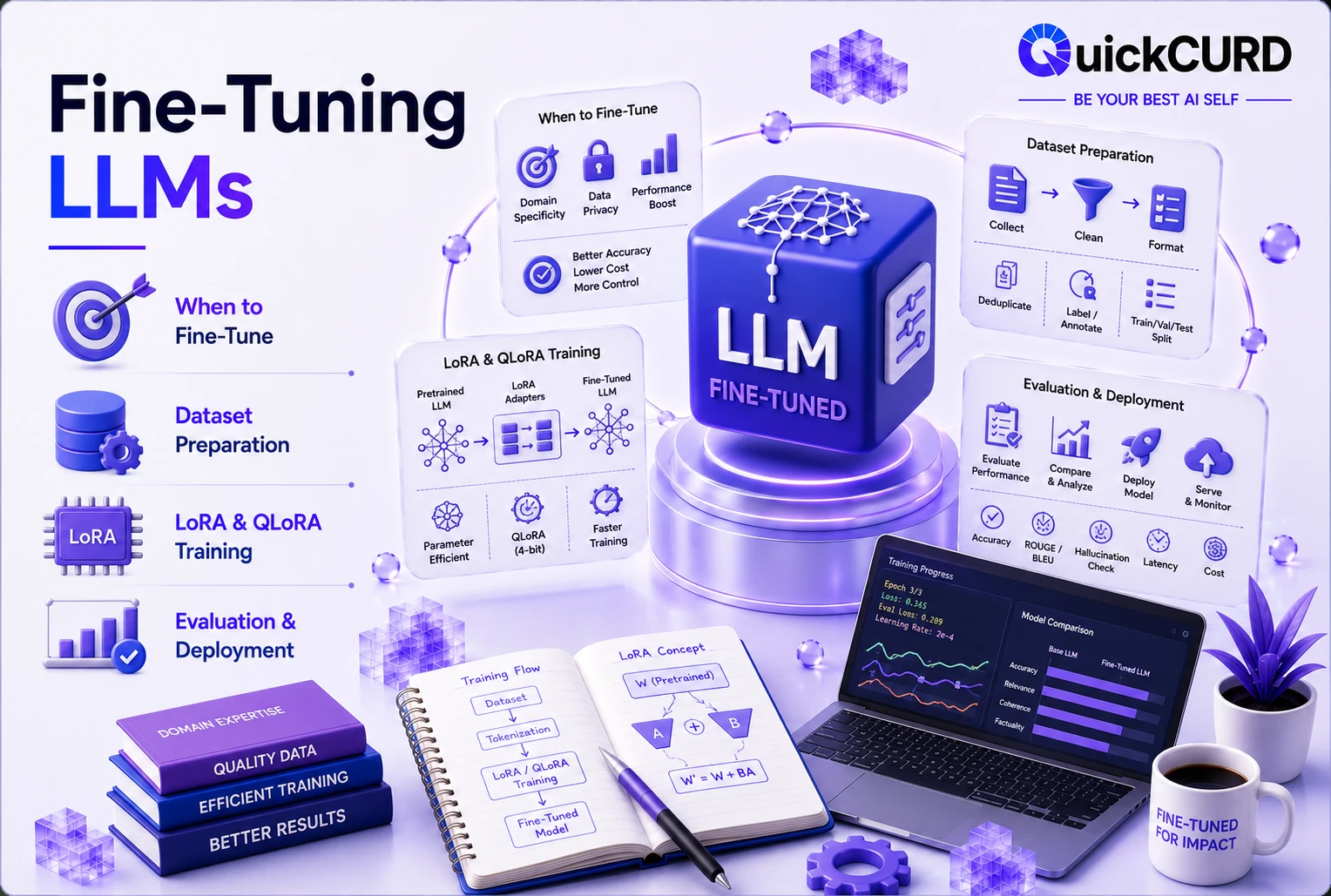
Decide when fine-tuning beats prompting and RAG, implement LoRA/QLoRA, prepare high-quality datasets, evaluate models, and deploy fine-tuned adapters to production.
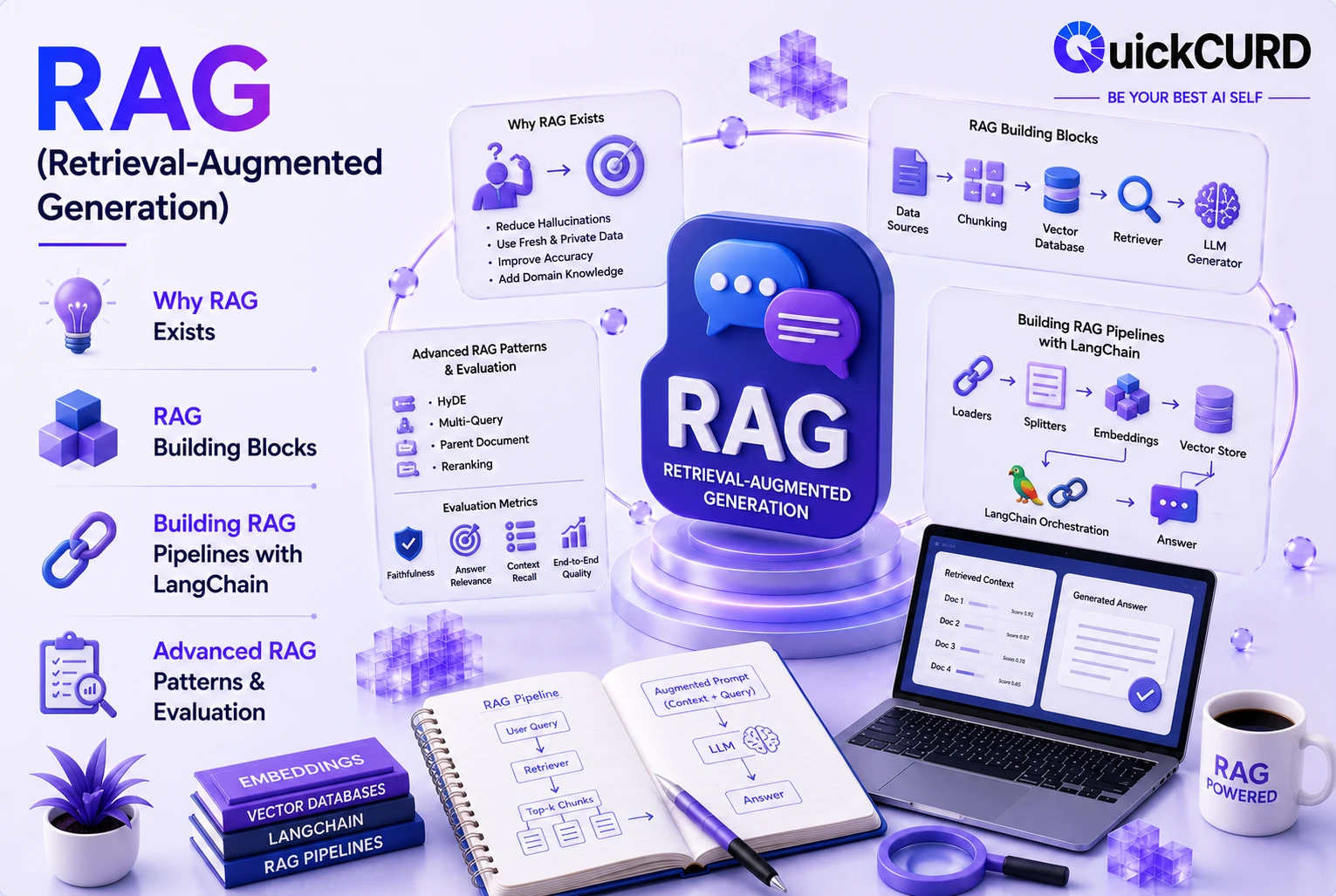
Understand why RAG solves hallucination and knowledge-cutoff problems, build complete RAG pipelines with embeddings and vector stores, and implement advanced retrieval patterns.