- Call: +91-8904100674
- Email: support@quickcurd.com

Instructor: Vinay Kumar
What you'll achieve
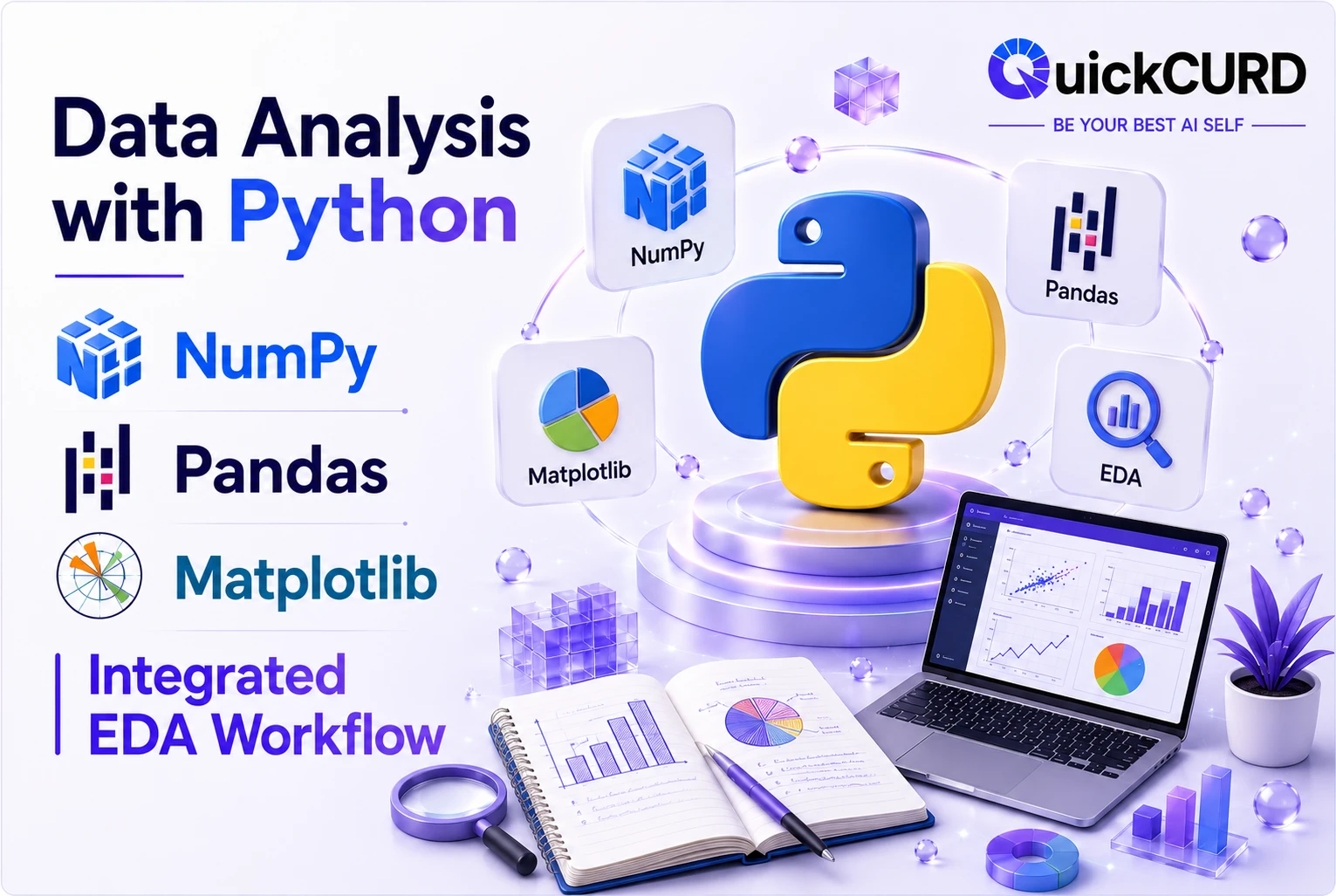
Manipulate numerical arrays with NumPy, wrangle structured data with Pandas, and create insightful visualisations with Matplotlib — the three pillars of every data science pipeline.
Fast numerical computing with arrays
• ndarray: creation, shapes, dimensions, dtypes
• Indexing, slicing, boolean masking
• Broadcasting: operations across different shapes
• Universal functions: sqrt, exp, log, sin
• Linear algebra: dot, matmul, transpose
• Random module: rand, randn, randint, seed
Structured data manipulation
• Series and DataFrame: creation and anatomy
• read_csv, read_excel, read_json
• head, tail, info, describe, dtypes
• loc, iloc, boolean filtering
• Handling missing values: isnull, dropna, fillna
• GroupBy, merge/join, apply() and map()
Visualising data clearly and effectively
• Figure and Axes architecture
• Line, scatter, bar, histogram, box plots
• Titles, labels, legends, annotations
• Subplots and colour map styling
End-to-end exploratory analysis
• Load → inspect → clean → analyse → visualise
• Correlation heatmaps and pair plots
• Missing value analysis and imputation Mini-project
• Project: EDA on a real dataset
KEY TAKEAWAYS
1. NumPy arrays are the backbone of all numerical ML computation
2. Pandas DataFrames handle 90% of real-world data wrangling
3. Broadcasting eliminates for-loops — think in arrays
4. A clear visualisation communicates more than a table of numbers
0 Reviews

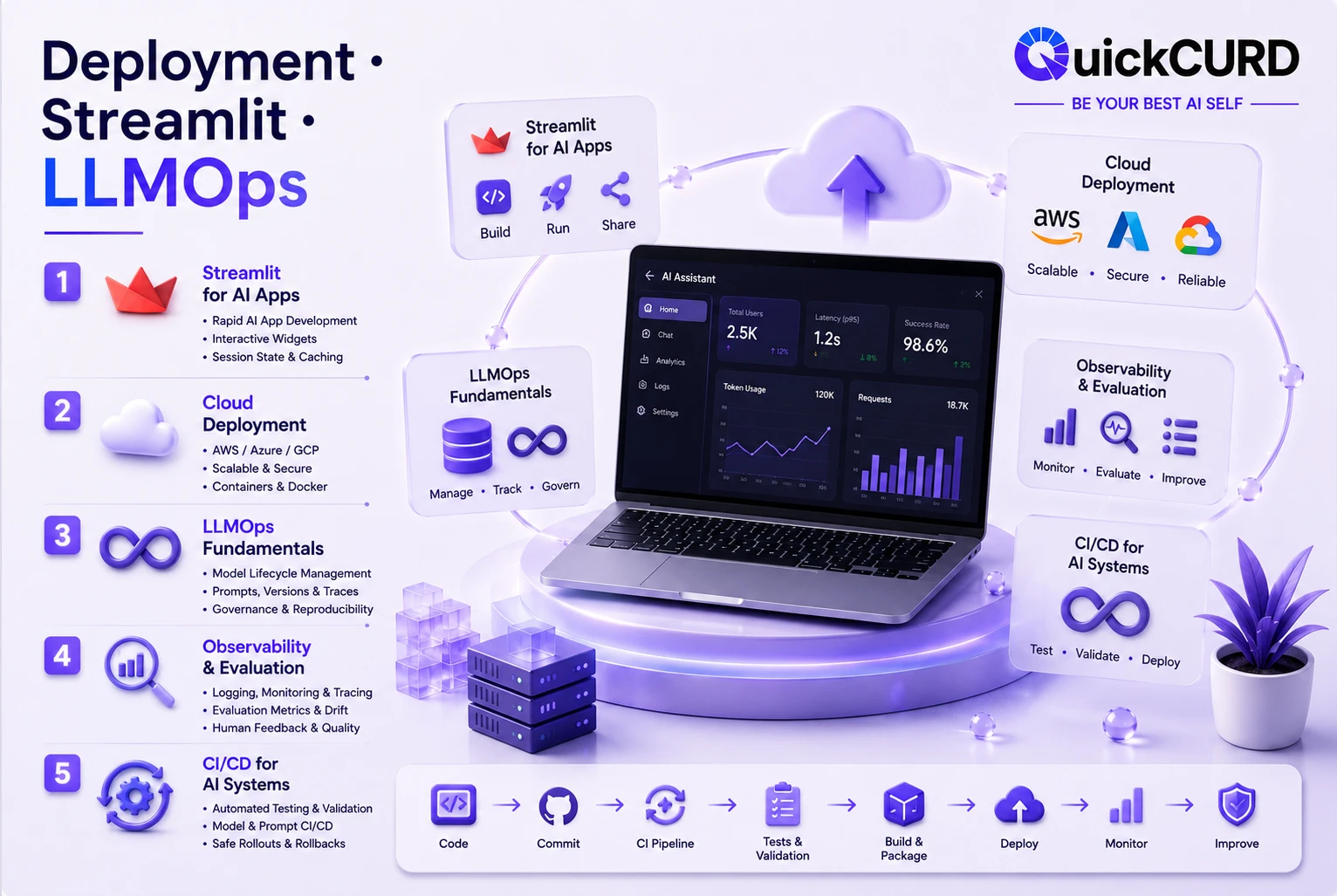
Package AI apps into Streamlit UIs, deploy on public cloud (AWS/GCP), implement LLMOps monitoring with LangSmith, establish CI/CD for AI, and understand LLMOps as a discipline.
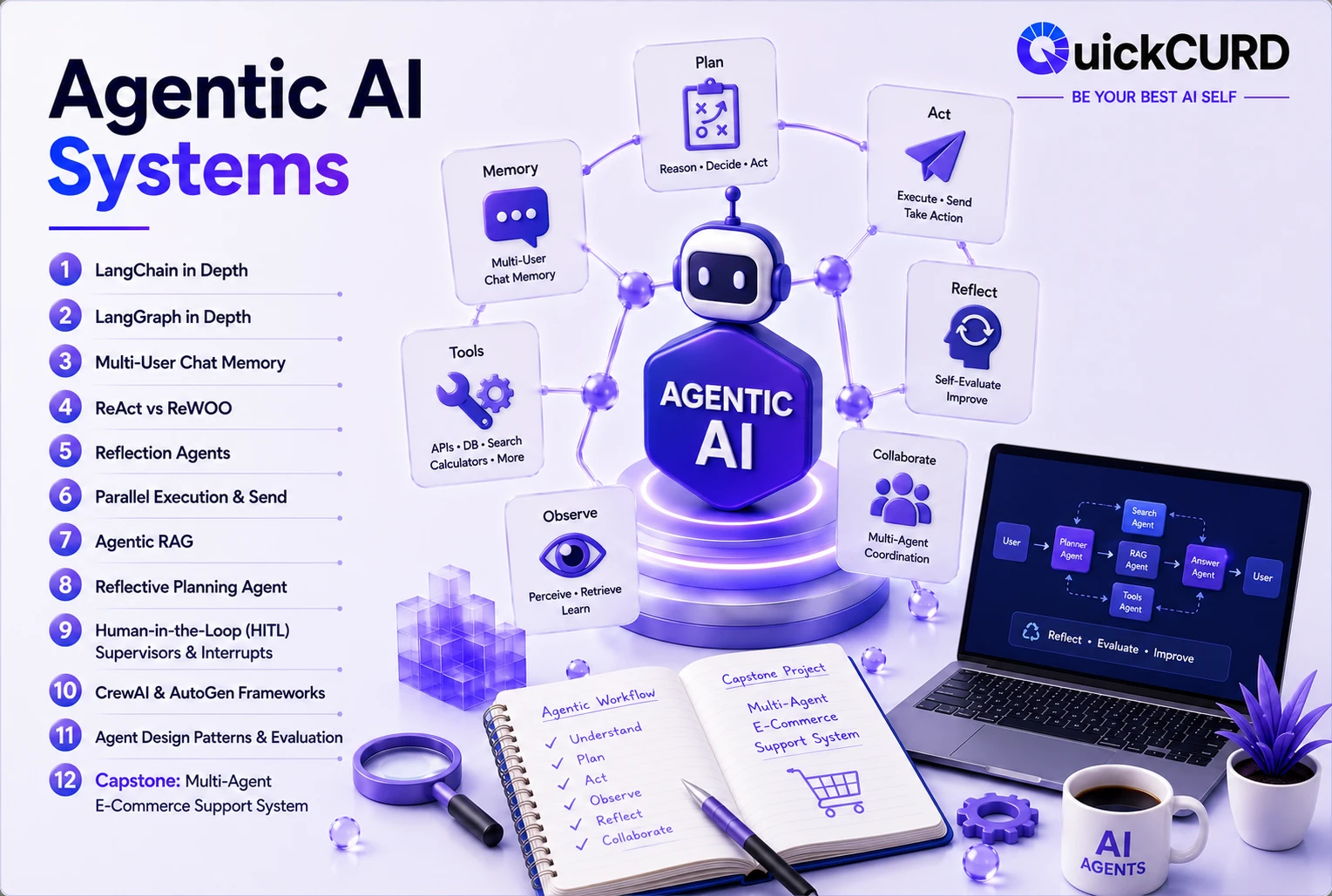
Build AI agents from first principles, design stateful LangGraph workflows, implement all major agent patterns compare CrewAI vs AutoGen, and ship a production multi-agent e-commerce support system.
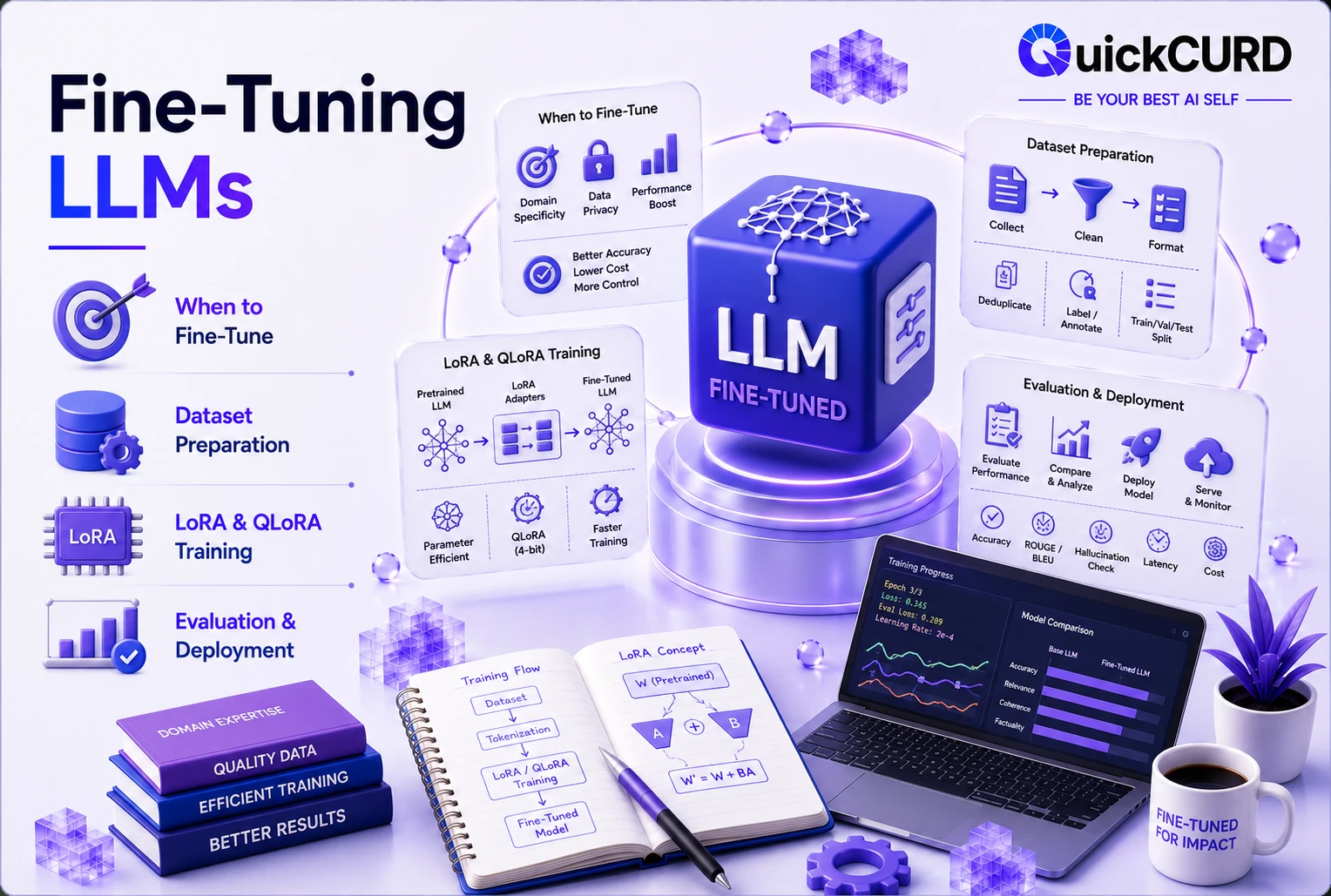
Decide when fine-tuning beats prompting and RAG, implement LoRA/QLoRA, prepare high-quality datasets, evaluate models, and deploy fine-tuned adapters to production.