- Call: +91-8904100674
- Email: support@quickcurd.com

Instructor: Vinay Kumar
What you'll achieve
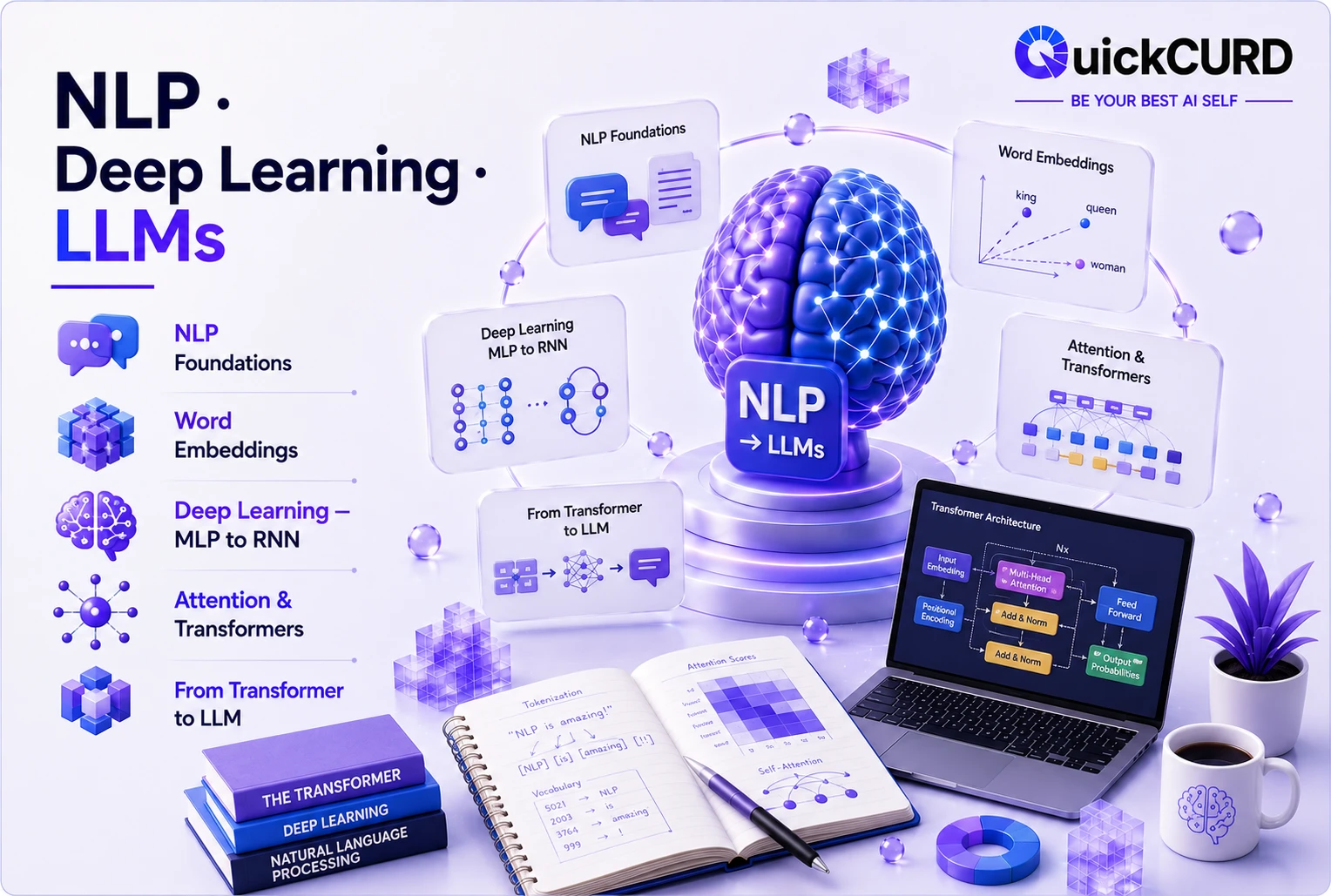
Master NLP fundamentals, build neural network intuition from MLP to LSTM, follow the evolutionary path through Attention to Transformers, and understand how LLMs are trained.
Text as data — processing the written word
• Corpus, vocabulary, OOV words
• Tokenisation: character, word, sub-word (BPE)
• Stemming, Lemmatisation, Stopword removal
• Vectorisation: One-Hot, BoW, TF-IDF, N-grams
• Practical: IMDB sentiment with TF-IDF + LR
Dense semantic representations
• Why one-hot fails: sparsity, no semantics
• Word2Vec: CBOW and Skip-Gram architectures
• GloVe: global co-occurrence statistics
• Vector arithmetic: King - Man + Woman = Queen
Create & Compare Sparse vs Dense Representation
Neural networks for sequence data
• Perceptron → MLP: forward pass and backprop
• Activation functions: ReLU, sigmoid, softmax
• CNNs for text classification
• RNNs and LSTMs: variable-length sequences
• Vanishing gradient — why Attention was needed
The breakthrough that changed everything
• Seq2Seq limitations and the attention fix
• Self-attention and multi-head attention
• Positional encoding: giving order to tokens
• BERT (encoder) vs GPT (decoder)
How modern AI came to exist
• Scaling laws: data + parameters = emergent capability
• GPT-1 → GPT-2 → GPT-3 → GPT-4 → GPT-5 lineage
• Instruction tuning and RLHF
• Tokens, context windows, temperature, top-p
• Open-source LLMs: LLaMA, Mistral, Falcon
1. Every LLM starts with tokenisation and embeddings
2. Attention solves the bottleneck RNNs couldn't
3. The Transformer is an architecture, not a model
4. Scaling laws: capability emerges from data + compute
5. RLHF turns raw LLMs into helpful assistants
0 Reviews

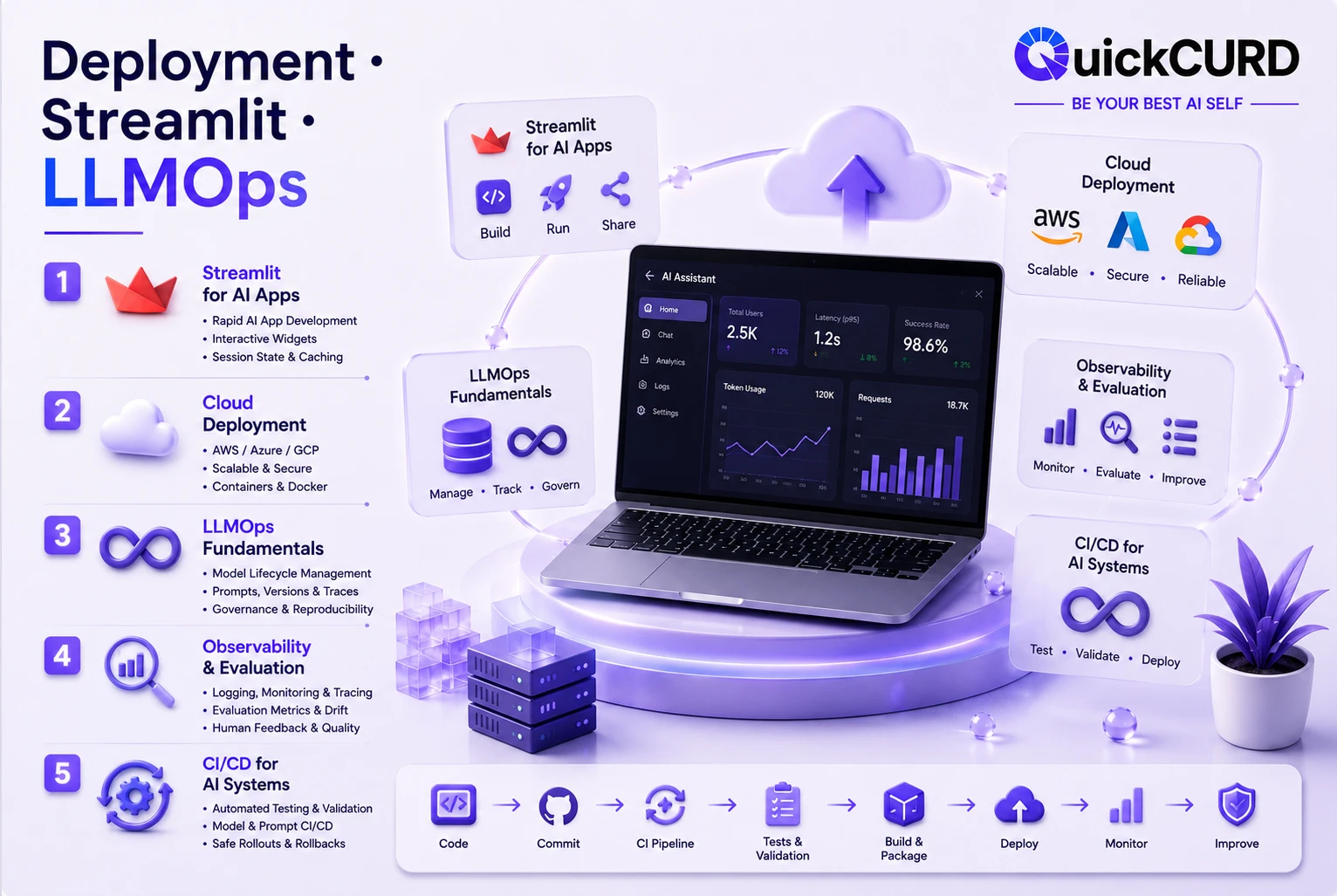
Package AI apps into Streamlit UIs, deploy on public cloud (AWS/GCP), implement LLMOps monitoring with LangSmith, establish CI/CD for AI, and understand LLMOps as a discipline.
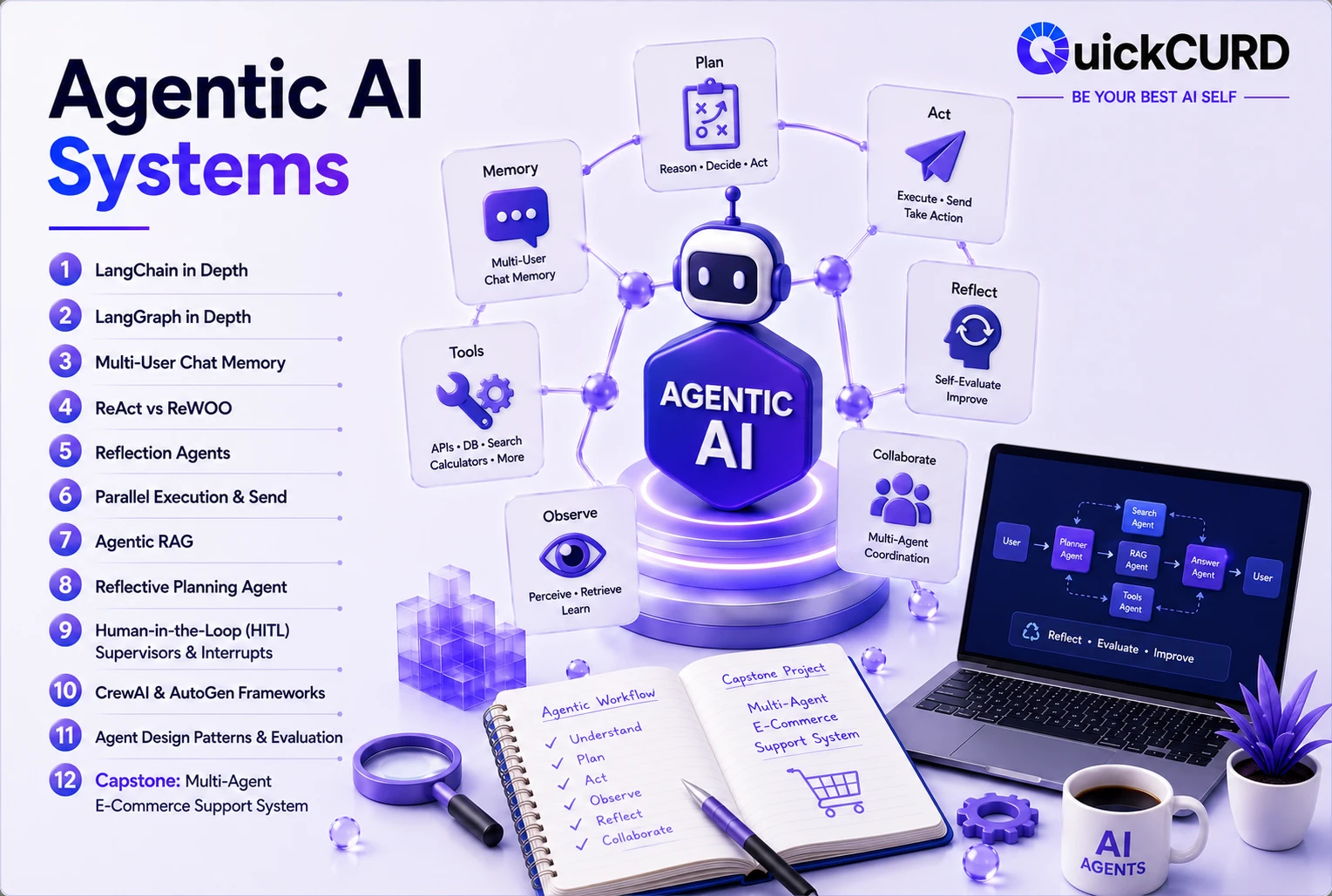
Build AI agents from first principles, design stateful LangGraph workflows, implement all major agent patterns compare CrewAI vs AutoGen, and ship a production multi-agent e-commerce support system.
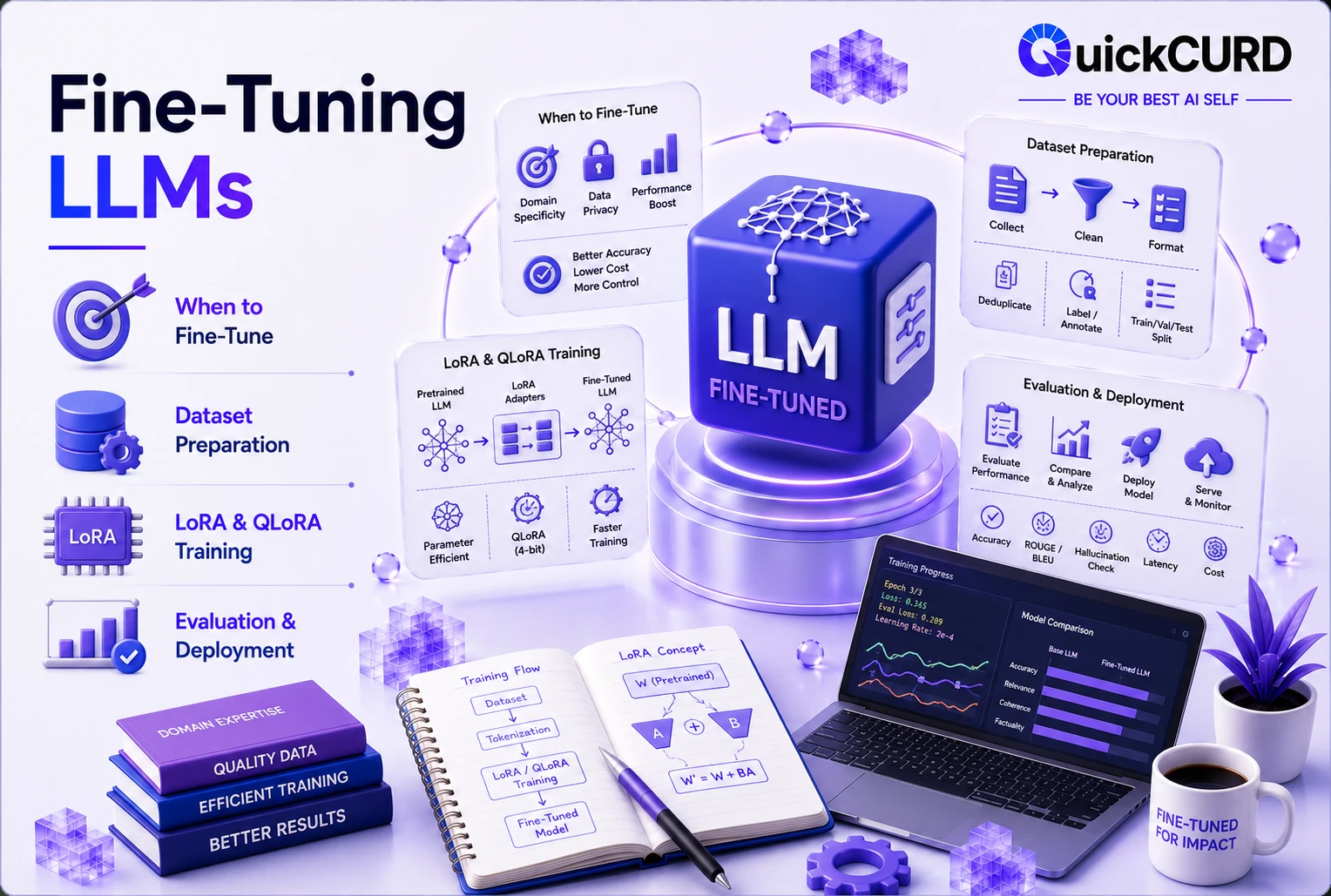
Decide when fine-tuning beats prompting and RAG, implement LoRA/QLoRA, prepare high-quality datasets, evaluate models, and deploy fine-tuned adapters to production.